AI enablement through internal talks
This post was originally published on the Typeform Engineering Blog.
As AI usage grows, organizations benefit from enablement, and this is becoming more and more relevant. At Typeform, one of the ways we’ve supported this is through our internal talks: Typetalks. I’m Miquel, the tech lead of one of the product teams, and I’ve been hosting and organizing these sessions for the past two years. In this post, I’ll share what we’ve learned, the challenges we’ve faced, and how Typetalks have helped enable AI across the company.
What are these sessions?
Typetalks are informal weekly sessions scheduled on an ad-hoc basis. They’re a safe space to share knowledge while also giving visibility into what’s happening across the company. They’re not exclusively technical, we also host product and design-oriented sessions. The format is up to the speaker, and sessions usually last between 30 and 60 minutes.
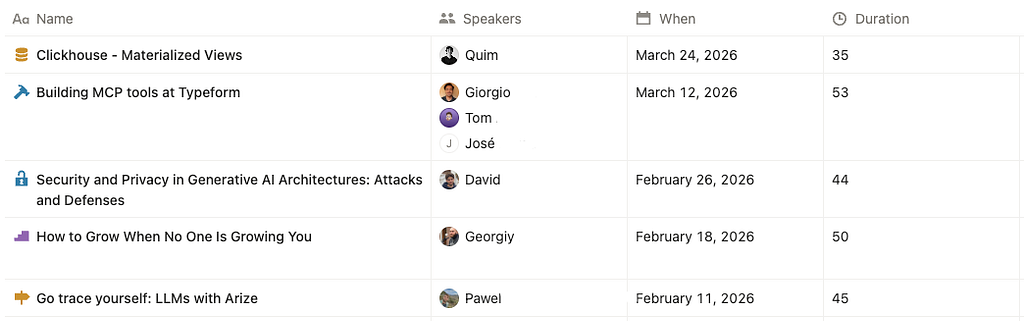
Some examples of real sessions done this year.
How did we introduce AI enablement in these sessions?
I’ll be honest: it just happened. After a little over a year of running these sessions, I looked back at what happened last year (2025) to spot any trends. One number stood out (though not entirely): after the summer, half of the sessions were AI-related.
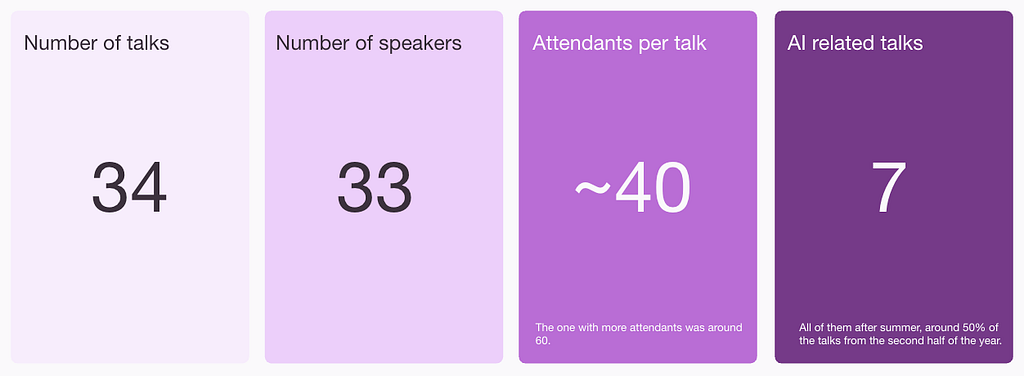
Some numbers I shared during the State of Typetalks session at a company all-hands.
That wasn’t a coincidence. It happened alongside the increased use of tools like Claude Code at the end of 2025. That made us consider Typetalks as an AI enablement tool, since speakers were genuinely interested in sharing these topics and attendees were keen to participate.
How is it going so far this year?
At the time of writing this article, we’ve done 27 Typetalks this year. 14 of them were AI-related, again, more than 50%. It wasn’t a coincidence; it’s still happening. However, not all of them are about enablement per se. We’ve covered different topics:
- Sessions where speakers show how they use AI in their day-to-day work. Live demos, some Claude Code utilities, and ways to save costs with caching and other tooling.
- Enablement of internal AI tooling. A few teams are working on internal tooling, and on enabling the agents engine behind Typeform AI and our Typeform MCP.
- Philosophical sessions about AI’s impact on our jobs. How trends are changing, how we’re adapting to them and to new tools, and how we still keep traditional ways of doing things in specific areas.
Challenges in organizing the sessions
Some of these sessions are organized organically, so speakers reach out because they want to share a specific topic, usually something aligned with current trends and what’s happening across the company. However, most of the time, people aren’t willing to speak, or they don’t yet realize they have a topic worth sharing. Everything starts with the discovery phase which includes finding topics interesting to cover and then tracking down the right speakers. I like to say that the challenge isn’t finding speakers, it’s finding the right topics to engage attendees.
In any organization, you’ll find different groups of AI users depending on their expertise and maturity with the tools. I like to categorize them into three groups (though the boundaries can be a bit fuzzy):
- Users who rely on AI heavily in their day-to-day work and try new tools as soon as they come out.
- Users who use AI but don’t have the time or interest to keep trying new tools.
- Users who are skeptical about using AI in some scenarios, or who still don’t know how to leverage it.
All three groups benefit the talks ecosystem. The first group helps us understand what’s trending and what’s worth featuring in a session. The second groups are also a great source of speakers to show how they use AI in their day-to-day work. The third group helps us identify knowledge gaps.
Impact in our organization
We don’t have specific numbers on AI adoption because it’s hard to tell whether these sessions were the only driver, but we can share a few examples of their impact:
- Boris Ballester, one of our engineers, prepared a session on saving costs with Claude Code. This led to an internal initiative to enable tools like caveman or RTK internally by default for all Claude Code users. It also helped us better understand and optimize our budget.
- Pol Borrellas, one of our product managers, prepared a session showing how he uses AI to write PRDs (Product requirements documents) and save time. It proved useful for other product folks, who began adopting some of the techniques he shared.
- Igor Marques, one of our AI engineers, prepared a session explaining how the agent ecosystem that powers Typeform AI works internally and what its core components are. Not all engineers at Typeform are that exposed to AI features, so it was a great session to enable others and introduce them to the agents internals.
Takeaways
- Internal talks are a great way to share AI knowledge. It’s hard to keep up with all the new developments, and some people may feel lost about how to improve their own workflows.
- Enablement starts within your organization. It won’t come only from engineers: you’ll also find people in other roles who want to improve their AI workflows, and who will share what they learn with the rest of the company if you give them the space.
- AI enablement isn’t a one-off effort. Leverage the people interested in exploring new tools and workflows, give them the space to do so, and then spread the word so others can adopt them as well.